
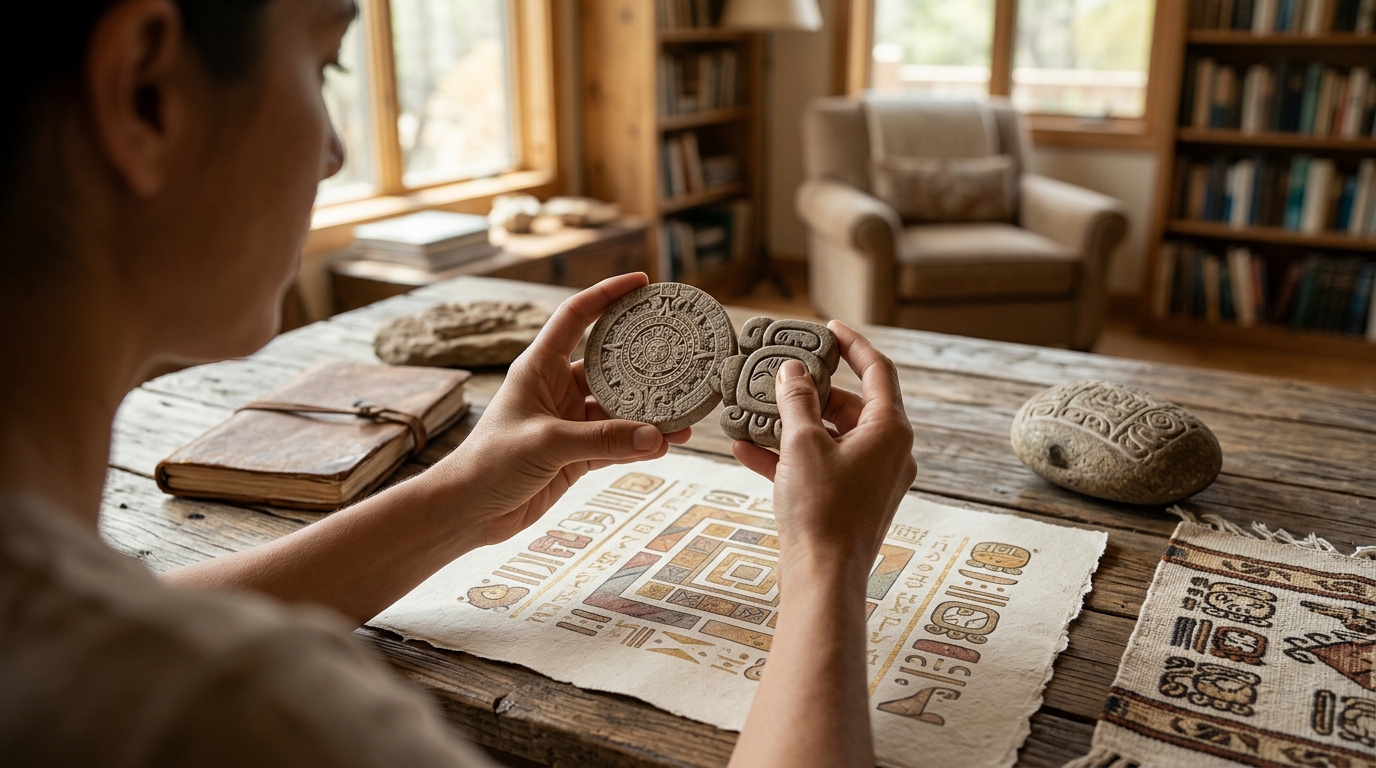
The Tzolkin calendar is built from two distinct sequences that interlock to create a unique 260-day cycle. The first component is a set of 20 Day Signs, and the second is a series of 13 Galactic Tones. When these two sequences move in parallel, they generate a specific combination for every single day. This structure allows the calendar to map time with a level of granularity that standard solar calendars do not provide. My Mayan Sign uses this precise mathematical framework to help users identify their personal Day Sign and Tone.
The 20 Day Signs
The Day Signs are the visual and symbolic core of the Tzolkin. Each sign represents a specific archetype or quality of energy. There are exactly 20 signs in the sequence, and they repeat in a fixed order. For example, the sign for Wind is associated with breath and spirit, while Earth represents stability and grounding. These signs are not random; they follow a strict linear progression. Understanding the specific meaning of each sign is the first step in reading the calendar. The visual symbol for each sign helps practitioners quickly identify the day's primary theme.
The 13 Galactic Tones
The Galactic Tones provide the numerical and energetic context for each Day Sign. A Galactic Tone is a number from 1 to 13 that modifies the character of the Day Sign. The tone indicates the intensity or phase of the energy. For instance, Tone 1 is often seen as a beginning or a seed, while Tone 13 represents completion or a peak. The combination of a specific sign and a specific tone creates a unique day. This means that the Day Sign Deer with Tone 7 is distinct from Deer with Tone 1. The tone adds a layer of nuance that the sign alone cannot provide.
The 260-Day Cycle
The interaction between the 20 signs and 13 tones creates a cycle of 260 days. This number is the least common multiple of 20 and 13. Because 20 and 13 are coprime, every possible combination of sign and tone appears exactly once in the 260-day period. After 260 days, the cycle resets to the first combination. This repeating pattern is the fundamental unit of the Tzolkin. It is often referred to as the Sacred Round. The cycle does not align with the solar year, which creates a complex interplay between the sacred and solar calendars.
Trecenas and the 13-Day Weeks
Within the 260-day cycle, there are 20 distinct periods known as Trecenas. A Trecena is a 13-day week that is dedicated to a single Day Sign. Each Trecena begins with Tone 1 and ends with Tone 13. For example, the Trecena of Wind contains all 13 tones associated with the Wind sign. This structure allows for a deeper analysis of how a specific sign evolves over 13 days. The Trecena provides a framework for understanding the progression of energy within a single sign. It helps practitioners see the full arc of a sign's influence before moving to the next.

Applying the Structure to Your Birth Date
Understanding these building blocks allows you to map your own birth date onto the Tzolkin. By counting back from a known reference point, you can determine your specific Day Sign and Tone. This personal mapping is the foundation of Mayan astrology. My Mayan Sign offers a free calculator that performs this count automatically. You simply enter your Gregorian birth date, and the system identifies your corresponding Tzolkin day. This tool removes the need for manual counting and ensures accuracy. It provides an immediate entry point into the system for beginners and a quick reference for experienced readers.
Key Takeaways
- The Tzolkin consists of 20 Day Signs and 13 Galactic Tones.
- The 260-day cycle is the least common multiple of 20 and 13.
- Each day is a unique combination of one sign and one tone.
- Trecenas are 13-day weeks dedicated to a single Day Sign.
- The cycle repeats every 260 days, creating a predictable pattern.
- Personal readings are derived by mapping a birth date to this cycle.
Frequently Asked Questions
How many days are in a Tzolkin cycle?
A Tzolkin cycle contains exactly 260 days. This number is derived from the combination of 20 Day Signs and 13 Galactic Tones.
What is the difference between a Day Sign and a Tone?
A Day Sign is the symbolic archetype (e.g., Wind, Earth), while a Tone is the numerical modifier (1-13) that defines the energy's phase.
Do the 20 signs repeat in a fixed order?
Yes, the 20 Day Signs always appear in a specific, unchanging sequence throughout the 260-day cycle.
What is a Trecena?
A Trecena is a 13-day period within the Tzolkin that focuses on a single Day Sign, moving through all 13 tones.
Can I calculate my Tzolkin day without a tool?
Yes, it is possible to count manually from a reference date, but using a calculator like the one on My Mayan Sign is faster and less prone to error.
Explore Your Personal Map
Now that you understand the structural components of the Tzolkin, you can begin to see how they apply to your own life. The system is a map of time and energy, and your birth date is your specific location on that map. To see your Day Sign and Tone, visit the My Mayan Sign calculator. This tool provides an instant reading based on the 260-day cycle. You can also explore how your sign interacts with others using the compatibility analysis. For a deeper dive into the daily rhythm, check out the today's calendar to see how the current day's energy aligns with your personal sign. My Mayan Sign is designed to make these ancient structures accessible and practical for modern users.