
What Does Each Day in the Mayan Calendar Cycle Represent and Mean?
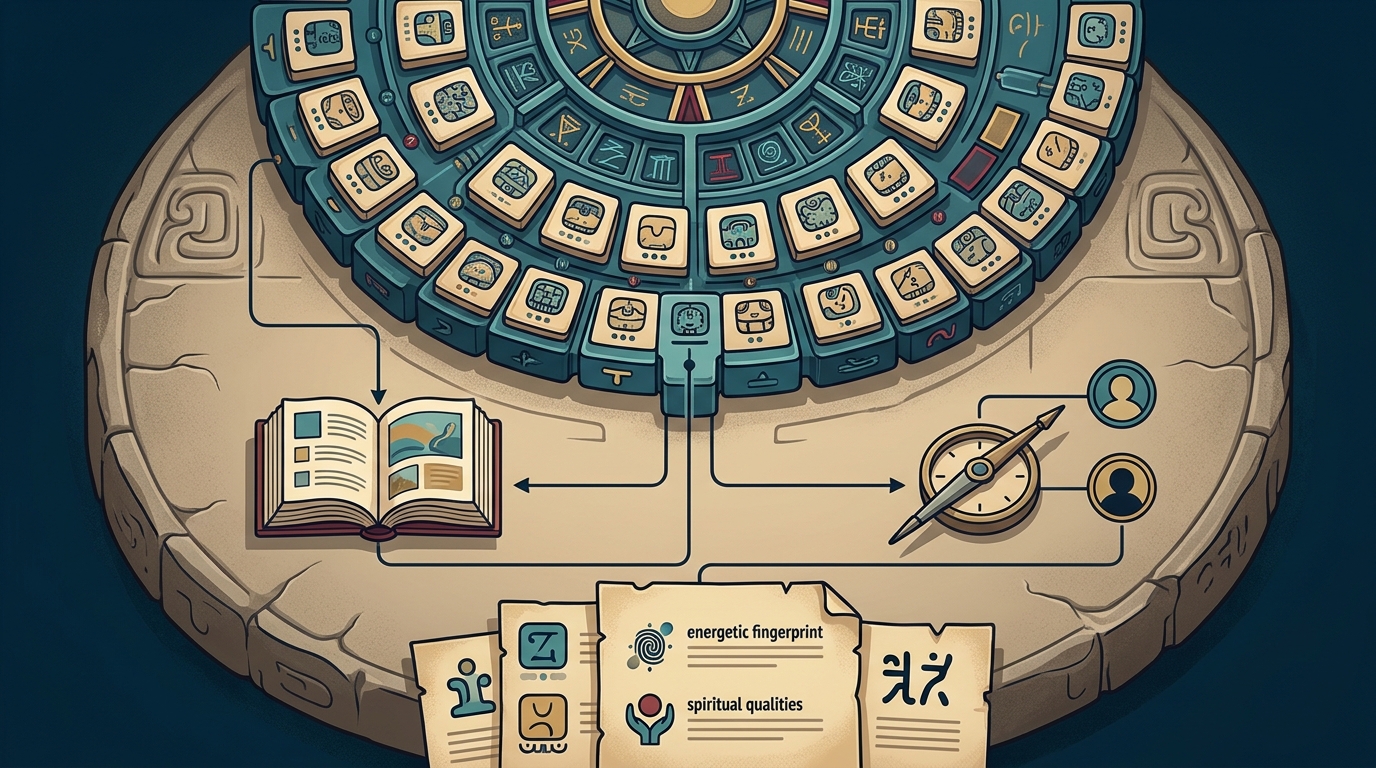
Each day in the Mayan calendar cycle represents a unique energetic fingerprint formed by combining one of 20 Day Signs with one of 13 Galactic Tones. This pairing creates 260 distinct days, each carrying specific spiritual qualities, personality traits, and life purposes. My Mayan Sign helps you decode these daily energies by calculating your personal birth date profile within this sacred 260-day Tzolkin system.
The Mathematical Structure of the 260-Day Cycle
The Tzolkin operates on a precise mathematical foundation that ensures no two days are identical within a single cycle. The system pairs 20 distinct Day Signs with 13 numbered Galactic Tones, creating a total of 260 unique combinations before the pattern repeats. This structure is not arbitrary; it reflects the Maya understanding of spiritual time as a continuous, cyclical flow rather than a linear progression. The 20 Day Signs represent different forms of life energy, often symbolized by animals, natural elements, or cosmic forces such as the jaguar, wind, seed, and star. Each sign carries a specific character or archetype that defines the primary energy of that day. The 13 Galactic Tones act as modifiers, describing the intensity, function, or manner in which that energy expresses itself. A tone of 1 represents a new beginning, while a tone of 13 signifies a culmination or completion. This interplay between the static identity of the Day Sign and the dynamic charge of the Tone creates a nuanced portrait for every single day in the cycle. For example, a day with the Jaguar sign and Tone 1 carries the energy of a new spiritual warrior, while the same Jaguar sign with Tone 13 represents the full realization of that warrior's power. This mathematical precision allows practitioners to track the subtle shifts in energy as the calendar moves forward. The cycle is divided into 20 segments of 13 days each, known as trecenas. Each trecena begins with Tone 1 and ends with Tone 13, creating a narrative arc of development and resolution. Understanding this structure is essential for interpreting what each day truly represents in the context of the larger cycle.
Decoding the 20 Day Signs and Their Meanings
The 20 Day Signs are the core identifiers of the Mayan calendar, each representing a distinct aspect of human experience and cosmic energy. These signs are often referred to as Nawales in the K'iche' tradition. Each sign has a specific meaning that influences the personality and life path of those born on that day. For instance, the Imix sign, symbolized by the crocodile, represents creation, beginnings, and deep intuition. It is associated with the primal forces of life and the nurturing aspect of existence. The Ik sign, represented by wind, signifies communication, clarity, and the flow of ideas. People born under this sign are often seen as natural communicators and inspirers. The Akbal sign, associated with night or darkness, embodies the dreamer and visionary, guided by intuition and mystery. It represents the liminal space where hidden truths emerge. The Kan sign, symbolized by the seed, brings growth, potential, and creativity. It is the energy of abundance and the potential for new life. The Chicchan sign, represented by the serpent, carries life force energy, passion, and transformation. It is associated with healing and the shedding of old skins. The Cimi sign, often translated as death, actually represents renewal, change, and the necessary endings that allow for new beginnings. The Manik sign, symbolized by the deer, brings peace, grace, and protection. It is associated with gentleness and the care of others. The Lamat sign, represented by the star, embodies beauty, harmony, and artistic energy. It is linked to fertility, joy, and the light of the cosmos. The Muluc sign, associated with water, brings emotional and spiritual healing. It is sensitive, compassionate, and deeply connected to the flow of feelings. The Oc sign, symbolized by the dog, represents loyalty, unconditional love, and friendship. It is guided by the heart and a strong sense of community. The Chuen sign, represented by the monkey, brings playfulness, creativity, and humor. It is intelligent and adaptable, often finding joy in the unexpected. The Eb sign, symbolized by the road, represents the traveler, destiny, and the journey of life. It is associated with movement and the pursuit of purpose. The Ben sign, associated with the reed, brings strength, leadership, and protection. It is a stabilizing force for family and community. The Ix sign, represented by the jaguar, embodies the spiritual warrior, magic, intuition, and courage. It is a powerful sign associated with transformation and inner strength. The Men sign, symbolized by the eagle, brings vision, strategy, and a higher perspective. It is associated with clarity and the ability to see the big picture. The Cib sign, represented by the owl, embodies forgiveness, knowledge, and enlightenment. It is associated with wisdom and the ability to see in the dark. The Caban sign, associated with the earth, brings grounding, mindfulness, and balance. It is stable, aware, and connected to the physical world. The Etznab sign, symbolized by the knife, represents truth-seeking and the cutting through of illusion. It is associated with clarity, precision, and the removal of falsehood. The Cauac sign, represented by the storm, brings purification, cleansing, and renewal. It is a powerful force that clears away stagnation. The Ahau sign, associated with light, embodies illumination, leadership, and confidence. It radiates warmth, wisdom, and a sense of divine connection. Each of these signs provides a unique lens through which to view the energy of a specific day in the cycle.
The Role of Galactic Tones in Shaping Daily Energy
While the Day Sign provides the character of the day, the Galactic Tone determines how that character is expressed. The 13 tones are numbered from 1 to 13, each carrying a specific vibrational quality. Tone 1 represents the seed of a new idea or beginning. It is the spark that initiates change. Tone 2 represents the growth and development of that initial spark. It is the stage where ideas take shape and begin to manifest. Tone 3 represents the expansion and sharing of the energy. It is the stage where the energy becomes visible to others. Tone 4 represents the consolidation and strengthening of the energy. It is the stage where the energy becomes more stable and defined. Tone 5 represents the peak of the energy's expression. It is the stage where the energy is at its most powerful and visible. Tone 6 represents the integration and balancing of the energy. It is the stage where the energy is absorbed and made part of the whole. Tone 7 represents the reflection and evaluation of the energy. It is the stage where the energy is assessed for its impact and meaning. Tone 8 represents the justice and fairness of the energy. It is the stage where the energy is balanced against a higher standard. Tone 9 represents the completion and fulfillment of the energy. It is the stage where the energy reaches its natural conclusion. Tone 10 represents the transition and release of the energy. It is the stage where the energy is let go to make way for something new. Tone 11 represents the wisdom and insight gained from the energy. It is the stage where the energy is understood on a deeper level. Tone 12 represents the love and compassion of the energy. It is the stage where the energy is shared with others in a caring way. Tone 13 represents the culmination and completion of the cycle. It is the stage where the energy is fully realized and ready to begin again. The combination of a specific Day Sign with a specific Tone creates a unique energetic signature for that day. For example, a day with the Jaguar sign and Tone 5 represents the peak of the spiritual warrior's power, while the same Jaguar sign with Tone 10 represents the release of that power to make way for a new cycle. Understanding the role of the tones is essential for interpreting the full meaning of each day in the Mayan calendar cycle.
How to Find Your Personal Day Sign and Tone
Discovering your personal Day Sign and Tone is a straightforward process that requires only your birth date. Unlike Western astrology, which relies on the position of planets and the time of birth, the Mayan system is based solely on the calendar date. This makes it accessible to anyone with a known birth date. The first step is to identify your place in the 260-day Tzolkin cycle. This can be done using a Mayan calendar calculator, which converts your Gregorian birth date into the corresponding Day Sign and Galactic Tone. My Mayan Sign offers a free calculator that performs this conversion instantly, providing you with your Day Sign, Tone, and Trecena. Once you have your Day Sign and Tone, you can begin to explore their meanings. Your Day Sign represents your core energy and life purpose, while your Tone indicates how that energy is expressed. For example, if your birth date corresponds to the Jaguar sign with Tone 8, your core energy is that of the spiritual warrior, and your expression of that energy is through justice and fairness. This combination suggests a person who is courageous and intuitive, with a strong sense of right and wrong. Your Trecena, the 13-day cycle that contains your birth date, provides additional context for your reading. It indicates the broader energetic environment in which you were born. By understanding your Day Sign, Tone, and Trecena, you gain a deeper insight into your personality, strengths, and challenges. This knowledge can be used for self-reflection, personal growth, and spiritual development. It is important to approach this information with an open mind and a willingness to explore its implications. The Mayan calendar is not a tool for prediction, but a mirror for self-understanding. It offers a map of your energetic landscape, allowing you to navigate your life with greater awareness and intention.
Practical Applications of Mayan Calendar Insights
The insights gained from the Mayan calendar can be applied in various aspects of life, from personal development to relationship dynamics. One practical application is in understanding compatibility between individuals. By comparing the Day Signs and Tones of two people, you can gain insight into the energetic dynamics of their relationship. For example, a person with the Jaguar sign may have a strong, transformative influence on a person with the Deer sign, who is gentle and protective. This combination can create a dynamic of strength and care, where the Jaguar provides direction and the Deer provides stability. Another application is in timing decisions and actions. By observing the current Day Sign and Tone in the calendar, you can align your activities with the prevailing energy. For example, if the current day is associated with the Wind sign and Tone 1, it may be a good time to start a new communication project or share an idea. If the current day is associated with the Earth sign and Tone 13, it may be a good time to complete a project or reflect on its outcomes. This practice of aligning with the calendar's energy can help you make more informed decisions and act with greater intention. The Mayan calendar can also be used for meditation and spiritual practice. By focusing on the energy of the current day, you can deepen your meditation and connect with the spiritual forces at play. For example, meditating on the Jaguar sign can help you tap into your inner strength and courage, while meditating on the Water sign can help you connect with your emotions and intuition. These practices can be used to cultivate specific qualities or to address specific challenges. The Mayan calendar is a powerful tool for self-awareness and spiritual growth, offering a unique perspective on the flow of energy in our lives. By integrating its insights into your daily practice, you can live with greater alignment and purpose.
Key Takeaways
- The Mayan calendar cycle consists of 260 unique days, each formed by a combination of one of 20 Day Signs and one of 13 Galactic Tones.
- Day Signs represent the core character or archetype of the day, such as the jaguar, wind, or seed, each with specific symbolic meanings.
- Galactic Tones modify the expression of the Day Sign, ranging from new beginnings (Tone 1) to culmination (Tone 13).
- Your personal Day Sign and Tone are determined solely by your birth date, requiring no birth time or planetary positions.
- The 260-day cycle is divided into 20 trecenas, each consisting of 13 days, creating a narrative arc of development and resolution.
- Understanding the combination of your Day Sign and Tone provides insight into your personality, strengths, and life purpose.
- The Mayan calendar can be used for self-reflection, compatibility analysis, and aligning actions with prevailing energies.
Frequently Asked Questions
What is the difference between the Mayan calendar and Western astrology?
The Mayan calendar is based on a 260-day cycle of Day Signs and Tones, while Western astrology is based on the positions of planets and constellations. The Mayan system does not require a birth time, only a birth date.
How many days are in the Mayan calendar cycle?
The Mayan calendar cycle, known as the Tzolkin, consists of 260 days. This is formed by combining 20 Day Signs with 13 Galactic Tones.
What does a Day Sign represent?
A Day Sign represents the core character or archetype of the day, such as the jaguar, wind, or seed. It defines the primary energy associated with that day.
What does a Galactic Tone represent?
A Galactic Tone represents the intensity or function of the Day Sign's energy. It ranges from 1 (new beginning) to 13 (culmination), modifying how the Day Sign is expressed.
How do I find my Mayan Day Sign?
You can find your Mayan Day Sign by using a Mayan calendar calculator with your birth date. My Mayan Sign offers a free calculator that provides your Day Sign, Tone, and Trecena instantly.
Is the Mayan calendar used for prediction?
The Mayan calendar is not used for prediction in the traditional sense. It is a tool for self-reflection and understanding the flow of spiritual energy, offering a map for personal growth and alignment.
What is a Trecena?
A Trecena is a 13-day segment of the 260-day Tzolkin cycle. Each Trecena begins with Tone 1 and ends with Tone 13, creating a narrative arc of development and resolution.
Explore Your Mayan Calendar Profile
Understanding the meaning of each day in the Mayan calendar cycle is the first step toward deeper self-awareness and spiritual alignment. By decoding your personal Day Sign, Galactic Tone, and Trecena, you gain a unique map of your energetic landscape. My Mayan Sign provides the tools and resources you need to explore this profound system. Whether you are new to Mayan astrology or a seasoned practitioner, our platform offers a clear and accessible way to connect with the sacred wisdom of the Tzolkin. Begin your journey today by calculating your personal profile and discovering the energies that shape your life.